
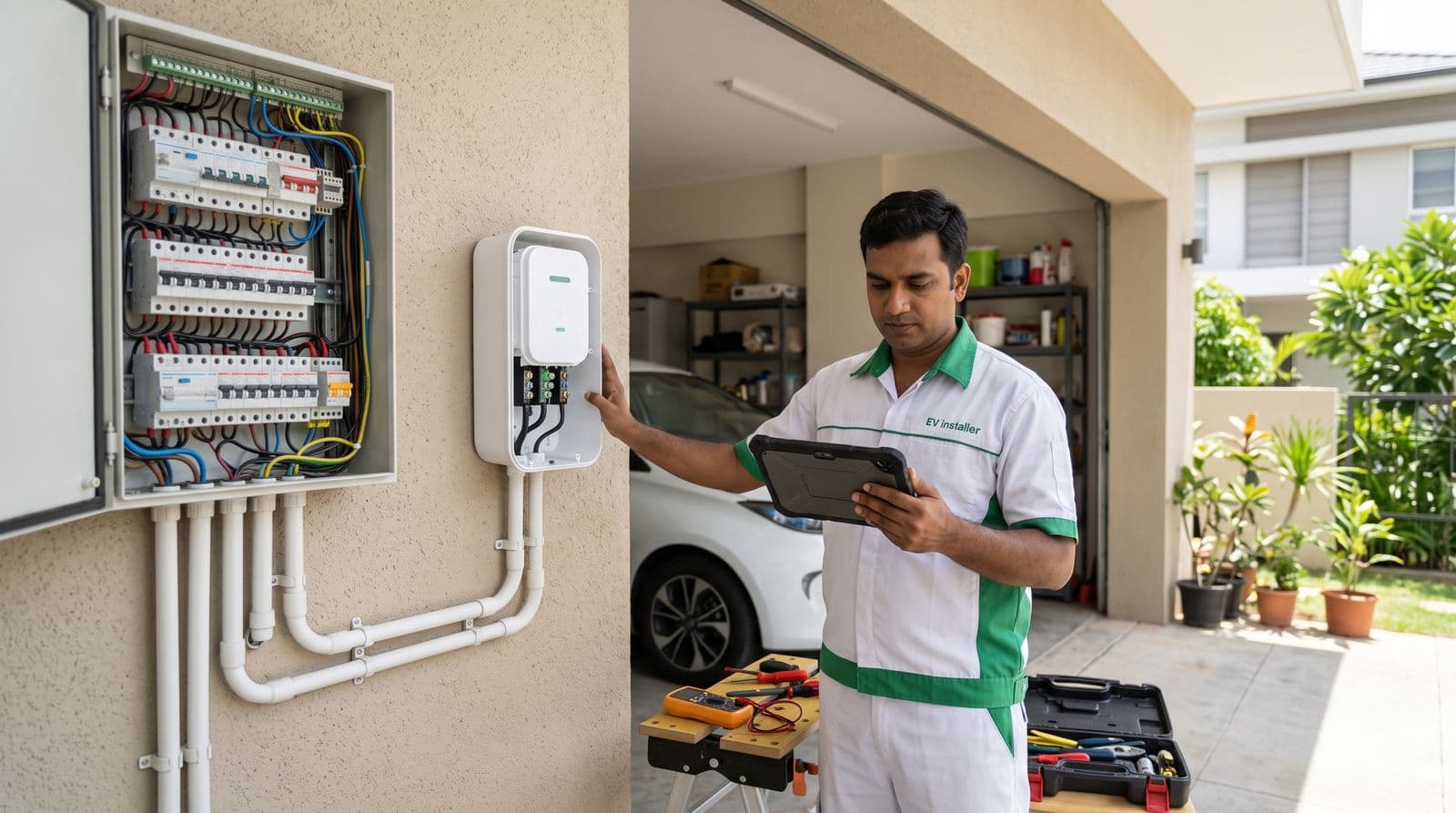
How it works
From enquiry to installed charger, step by step.
Our process is designed to be clear and safety-first, whether you are a homeowner, a community or a business.
The process
Eight steps to a safely installed charger
Some steps, such as the site inspection, are only needed where the initial assessment shows they are required.
- 01
Submit an enquiry
Fill in the installation or consultation form, call us, or message us.
- 02
Share your details
Tell us about your vehicle, your charger (if you already have one) and your property.
- 03
Initial technical assessment
We review your details and check basics such as connection type and sanctioned load.
- 04
Site inspection, if required
An inspection of the parking location, distribution board, earthing and cable route.
- 05
Quotation and installation plan
A clear quotation and plan covering the charger, materials, works and any approvals needed.
- 06
Confirm the installation
Approve the quotation and agree a convenient installation date.
- 07
Installation and safety checks
Installation of the charger and its circuit, followed by applicable safety checks and testing.
- 08
Handover and usage guidance
We show you how to use the charger safely and share the relevant documentation.
Our 48-hour service target
Site survey within 48 hours of your enquiry, and installation within the following 48 hours.
Subject to site readiness, customer availability and operational feasibility.
Before you enquire
What to keep ready
Having these details handy helps us assess your requirement quickly.
- Your EV make and model
- Whether you already have a charger (and its model, if so)
- Your property type and where you park
- A recent electricity bill showing your sanctioned load and connection type
- Photos of your parking spot and electrical distribution board (optional but helpful)
- For apartments: whether you have permission from your association or society
Homeowners & EV owners
Book a home charger installation and we will start with an assessment of your vehicle and property.
Book an InstallationOEMs, dealerships, fleets & communities
Business projects start with a consultation to understand your sites, users and goals.
Request a ConsultationQuality & safety
Installation standards you can rely on
Electricity and vehicles demand care. Every Amphive installation follows the same safety-first process, from assessment to handover.
[Certifications, electrical licences, authorisations and insurance details to be confirmed by Amphive before publishing.]
- Electrical-readiness assessment before every installation
- Dedicated circuit with protection devices as specified by the charger manufacturer
- Earthing checked as part of the assessment
- Installation in line with applicable electrical safety regulations, including the CEA (Measures relating to Safety and Electric Supply) Regulations, 2023
- Applicable safety checks and testing before handover
- Usage guidance and documentation at handover
You submit an enquiry and share your vehicle, charger and property details. We complete an initial technical assessment, arrange a site inspection if required, and send a quotation and installation plan. Once you confirm, we install the charger, carry out applicable safety checks and hand it over with usage guidance.
Check your vehicle’s AC charging limit, whether your supply is single-phase or three-phase, your sanctioned load, where the charger will be mounted relative to your parking spot, and whether you need permission from a landlord, association or society.
Your name and contact details, city and area, EV make and model, property type (independent house, apartment or other), whether you have already bought a charger, and any specific requirements. Photos of your parking spot and distribution board are helpful but optional.
Our service target is a site survey within 48 hours of your enquiry and installation within the following 48 hours, subject to site readiness, customer availability and operational feasibility (for example, approvals such as a load enhancement can take longer).
No. Let us know whether you already have a charger. If you do, we assess it for your site; if not, we discuss suitable options during the assessment.
Many cars come with a portable charger for a 15 A socket, which works for occasional charging if the socket and wiring are in good condition. For regular charging, a dedicated, protected circuit is safer and usually faster.